【研究背景】
在當(dāng)前大型電化學(xué)儲(chǔ)能系統(tǒng)中,鋰離子電池與液流電池均是重要的技術(shù)路線。液流電池憑借其本質(zhì)安全性高、功率與容量可獨(dú)立設(shè)計(jì)等突出優(yōu)勢(shì),尤其適合大規(guī)模儲(chǔ)能應(yīng)用,但其成本目前仍顯著高于磷酸鐵鋰電池。其中,隔膜成本占比高達(dá)15–40%,因此無膜化被視為降低電池整體成本的關(guān)鍵途徑之一。然而,現(xiàn)有的雙相無膜電池面臨功率性能不足的挑戰(zhàn):其電流密度普遍處于0.05~6 mA cm-2范圍內(nèi),遠(yuǎn)低于全釩液流電池的80~300 mA cm-2。這一性能差距不僅限制了電池對(duì)電網(wǎng)快速功率調(diào)節(jié)需求的響應(yīng)能力,更因其低電流密度導(dǎo)致系統(tǒng)體積龐大、材料用量增加,從而削弱了無膜化帶來的成本優(yōu)勢(shì),構(gòu)成了制約其工程化應(yīng)用的主要瓶頸。
【工作簡(jiǎn)介】
近日,天津大學(xué)胡文彬教授團(tuán)隊(duì)吳忠教授課題組提出并采用了一種薄膜電極方法,首次完整剖析了雙相無膜電池的復(fù)雜反應(yīng)過程,提出了的電解質(zhì)設(shè)計(jì)新策略。研究發(fā)現(xiàn),液-液界面離子轉(zhuǎn)移是限制電池倍率性能的關(guān)鍵步驟,并以此為指導(dǎo)設(shè)計(jì)出以PF6-等為支持電解質(zhì)鹽的體系,實(shí)現(xiàn)了高達(dá)11 mA cm-2(4C)的穩(wěn)定充放電電流密度,顯著超越以往報(bào)道的雙相無膜電池性能。該研究不僅首次揭示了界面離子轉(zhuǎn)移在電池中的的動(dòng)力學(xué)影響,還為高倍率雙相電池的電解質(zhì)篩選與設(shè)計(jì)提供了系統(tǒng)性方法。相關(guān)成果發(fā)表于國(guó)際知名期刊Advanced Functional Materials。李新宇博士為本文第一作者。
【內(nèi)容表述】
雖然雙相無膜電池研究發(fā)展迅速,但其倍率受限的根本原因仍未得到清晰闡明。這是因?yàn)槠涔ぷ鬟^程是一個(gè)多步驟耦合的復(fù)雜體系(包括體相離子遷移、電極表面電荷反應(yīng)、活性物質(zhì)擴(kuò)散傳質(zhì)以及關(guān)鍵的液-液界面離子轉(zhuǎn)移,圖1),傳統(tǒng)研究難以將這些步驟的影響分離。為此,該論文提出薄膜電極方法,通過模擬真實(shí)電池中由活性物質(zhì)氧化還原驅(qū)動(dòng)的離子轉(zhuǎn)移過程,并結(jié)合方波伏安技術(shù)分析不同頻率響應(yīng),使得精確評(píng)估液-液界面離子轉(zhuǎn)移這一速率控制步驟成為可能。
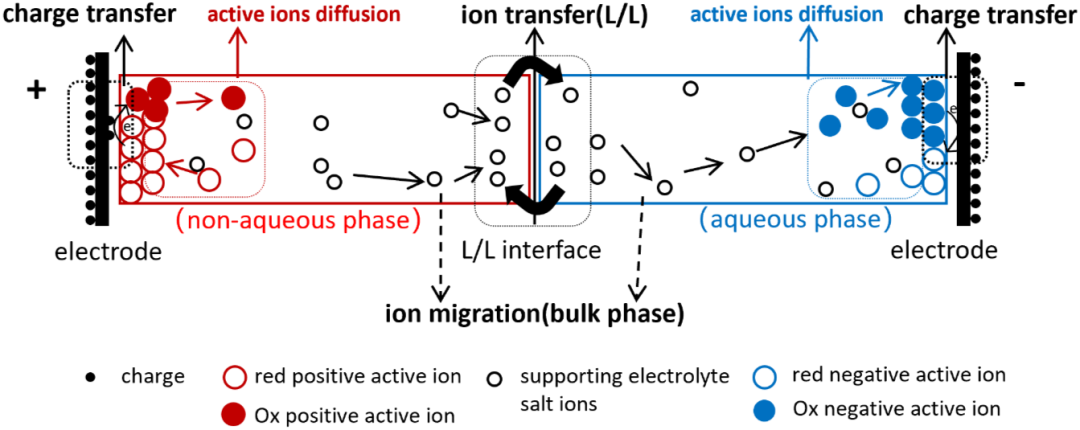
Figure 1 Multiple steps for BMF battery reactions during charging process.
研究首先通過不同支持電解質(zhì)鹽電導(dǎo)率與電池性能對(duì)比測(cè)試(圖2),發(fā)現(xiàn)電導(dǎo)率與倍率性能之間無明確正相關(guān)趨勢(shì),暗示界面過程的關(guān)鍵作用。隨后,采用方波伏安法與電化學(xué)阻抗譜分析,確認(rèn)液-液界面離子轉(zhuǎn)移為速率控制步驟(圖3)。進(jìn)一步通過循環(huán)伏安法測(cè)量離子轉(zhuǎn)移電位,結(jié)合分子動(dòng)力學(xué)模擬計(jì)算溶劑化能,揭示PF6-因在水相中脫溶劑能最低、轉(zhuǎn)移電位最小,因而具有最優(yōu)的界面轉(zhuǎn)移能力與趨勢(shì)(圖4)。最終,基于不同鹽離子電解液的方波伏安曲線中的最大無量綱電流密度值(反應(yīng)表觀動(dòng)力學(xué)速率,圖5)與電池性能比較,建立電解液篩選原則,指導(dǎo)高倍率性能電池設(shè)計(jì)(圖6)。實(shí)驗(yàn)最終還對(duì)該指導(dǎo)原則的適用性在其它雙相體系進(jìn)行了驗(yàn)證。
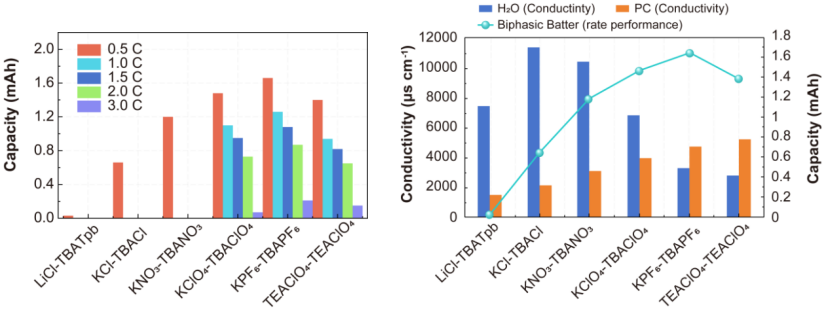
Figure 2 (a) Rate performance of BMF batteries with different supporting electrolyte salts (0.1 M) and active materials of ZnSO4/TEMPO (20 mM); (b) Change trend of rate performance with the conductivity of supporting electrolyte salts in aqueous and PC phases.
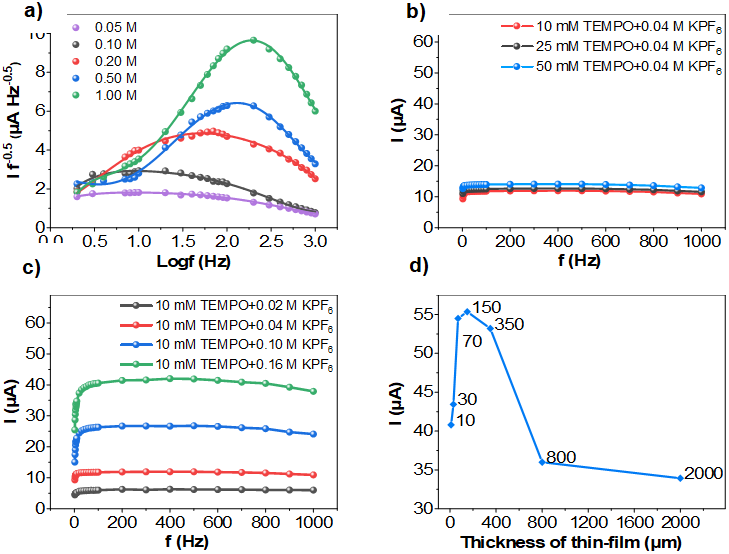
Figure 3 (a) MVDCD obtained by SWV measurement for the battery with PF6- ion of different concentrations (0.1 M, 0.2 M, 0.5 M and 1.0 M aqueous solution); (b) Relationship of peak current density and frequency of KPF6 (0.04 M aqueous solution) and TEMPO with varying concentrations (10, 25, 50mM PC solution); (c) Relationship of peak current density and frequency of KPF6 with varying concentrations (0.02, 0.04, 0.10, 0.16 M aqueous solution) and TEMPO (10 mM PC solution); (d)Relationship of peak current density and frequency of different film thickness (10, 30, 70, 150, 350, 800, 2000 μm) with LiClO4 (0.1 M aqueous solution) and TBAClO4 (0.1 M PC solution) and TEMPO (1 mM PC solution).
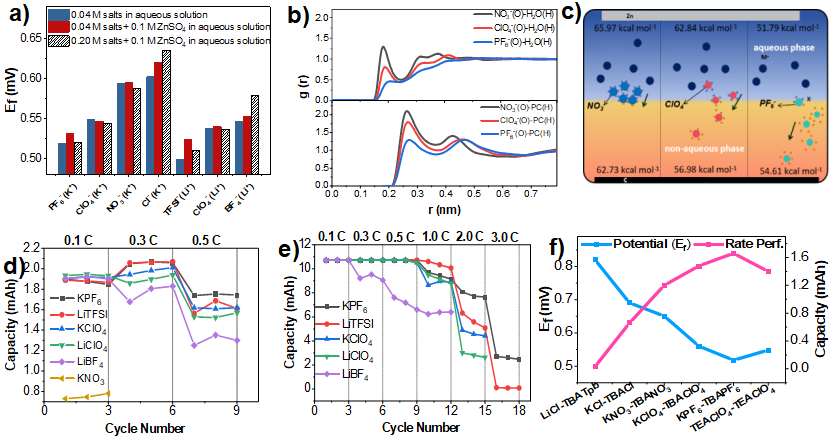
Figure 4 (a)The formal potential of different supporting electrolyte salts;(b) Radial Distribution Functions of PF6-, ClO4- and NO3- anions in aqueous and PC Phases; (c) Schematic diagram of ion transfer process for PF6-, ClO4- and NO3- anions from aqueous phase to non–aqueous one and the corresponding solvation energy in the two phases; (d) Discharge capacity of BMF batteries with different supporting electrolyte salts (0.04 M aqueous solution) at low–rate from 0.1 C to 0.5 C; (e) Discharge capacity of BMF batteries with different supporting electrolyte salts (0.20 M aqueous solution) from 0.1 C to 3.0 C; (f) The relationship between formal potential and rate performance of BMF batteries with different supporting electrolyte salts.
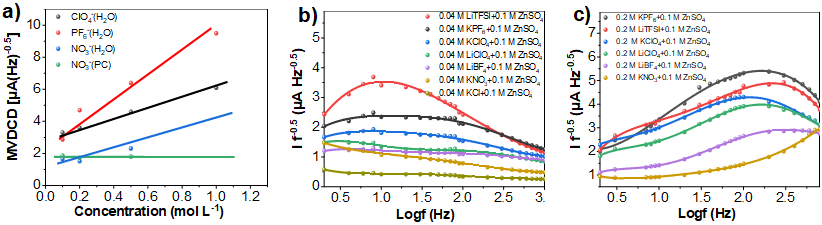
Figure 5 (a) Relationship between MVDCD and the concentration of supporting electrolyte salts (KPF6, KClO4, KNO3); (b) MVDCD of the batteries with active substance of ZnSO4 (0.1 M aqueous solution) and supporting electrolyte salts (KPF6, KClO4, KNO3, KCl, LiClO4, LiBF4, LiTFSI; 0.04 M aqueous solution); (c) MVDCD of the batteries with active substance of ZnSO4 (0.1 M aqueous solution) and supporting electrolyte salts (KPF6, KClO4, KNO3, LiClO4, LiBF4, LiTFSI; 0.2 M aqueous solution).
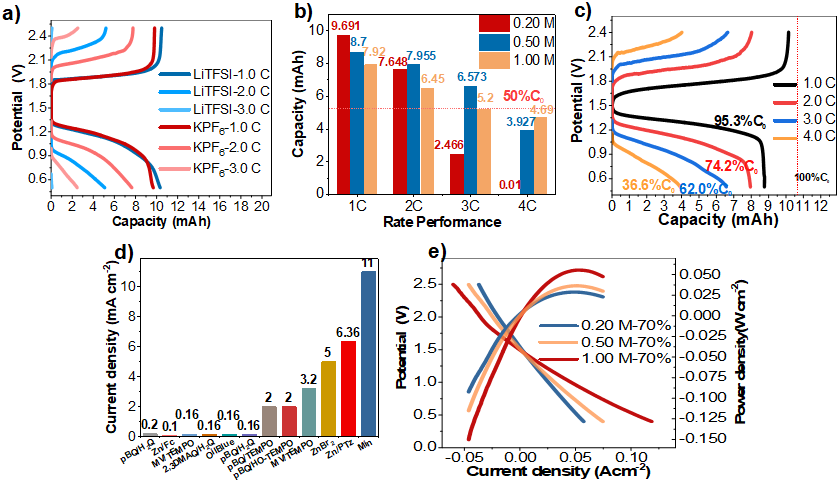
Figure 6 (a) Charging and discharging curves of the batteries with active substance of ZnSO4/TEMPO (0.1 M) and supporting electrolyte salt ofLiTFSI and KPF6(0.2 M aqueous solution) at different rates from 1C to 3C; (b)Discharge capacity of the batteries with different concentrations (0.2 M, 0.5 M, and 1.0 M aqueous solution) of supporting electrolyte salt (KPF6) for testing at different rates from 1C to4 C; (c) Charging and discharging curves of the batteries with active substance of ZnSO4/TEMPO (0.1 M) and supporting electrolyte salt of KPF6(0.5 M aqueous solution) at different rates from 1C to4 C; (d)Rate performance (current densities) of all BMF batteries in published literature; (e)Power performance of the batteries with active substance of ZnSO4/TEMPO (0.1 M) and supporting electrolyte salt of KPF6 with different concentrations (0.2 M, 0.5 M and 1.0 M aqueous solution).
核心結(jié)論
本研究最終明確了液-液界面離子轉(zhuǎn)移是雙相無膜電池的速率控制步驟,并建立了“離子轉(zhuǎn)移電位與離子轉(zhuǎn)移速率“與雙相電池倍率性能之間聯(lián)系,并提出高倍率電解液設(shè)計(jì)原則。基于該策略設(shè)計(jì)的KPF6體系在4C倍率下實(shí)現(xiàn)11 mA cm-2的放電電流,LiTFSI體系容量利用率在1C下達(dá)97%,均為目前報(bào)道的最高水平。該方法也適用于PEG/水、離子液體/水等多種雙相體系,展現(xiàn)了良好的普適性與應(yīng)用潛力。
【文獻(xiàn)詳情】
Electrolyte Design for High–Rate Performance Biphasic Membrane–Free Batteries
Xinyu Li, Yingjie Liu, Shuming Liu, Zhenbo Qin, Chengshuai Sun, Yida Deng, Zhong Wu*, Wenbin Hu,Advanced Functional Materials,2026