信件措辭嚴厲,高階半導體未來堪憂
14nm、7nm、28nm、55nm分別應用在哪類芯片上?
由于疫情的原因,這半年來全球半導體產能大缺貨,各大企業紛紛漲價,全球車企甚至停產,擴張半導體產能已經是迫在眉睫。
很多人認為國內最缺的工藝是各種先進工藝,比如14nm,7nm甚至5nm等,這些是我們生活中常見的半導體制程,廣泛應用與手機、筆記本等消費領域,然而實際情況可能大出意外。
7nm

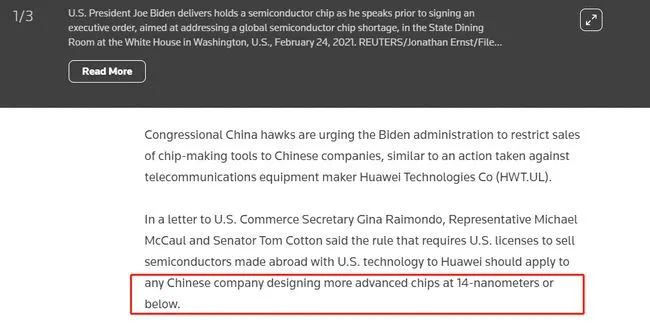
(Reuters) -Congressional China hawks are urging the Biden administration to restrict sales of chip-making tools to Chinese companies, similar to an action taken against telecommunications equipment maker Huawei Technologies Co.
In a letter to U.S. Commerce Secretary Gina Raimondo, Representative Michael McCaul and Senator Tom Cotton said the rule that requires U.S. licenses to sell semiconductors made abroad with U.S. technology to Huawei should apply to any Chinese company designing more advanced chips at 14-nanometers or below.
The letter, which is dated April 13 and was made public on Thursday, seeks licenses for the sale of electronic design automation (EDA) software, among other curbs on chip-related sales to Chinese companies.
The actions would "ensure U.S. companies as well as those from partner and allied countries are not permitted to sell the communists the rope they will use to hang us all," the letter said.
A representative of the Commerce Department, acknowledging receipt of the letter, noted that seven Chinese supercomputing entities were placed on a trade blacklist last week.
The agency is "continually reviewing circumstances to determine whether additional actions are warranted," the person said.
The United States last year issued a rule requiring licenses for sales of semiconductors to Huawei made overseas with U.S. chip-making equipment, expanding its reach to halt exports to the company.
Huawei was added to the Commerce Department's "entity list" in 2019 over national security and foreign policy concerns.
The blacklisting restricted sales to Huawei from U.S. suppliers, but did not crack down on commercially available chips made abroad. In response, the United States expanded the Foreign Direct Product Rule, which subjects foreign-made goods based on U.S. technology or software to U.S. regulations, for Huawei.
This week's letter was sent after Tianjin Phytium Information Technology and six other Chinese supercomputing entities were placed on the entity list for supporting military modernization efforts.
Cotton and McCaul want to not only restrict U.S. sales to Phytium, but to require a license for any company that uses American tools to make a Phytium-designed semiconductor chip.
Anything short, they said, "would be a half measure masquerading as a forceful action."
(Reporting by Karen Freifeld in New YorkEditing by Chris Sanders and Matthew Lewis)

往期回顧
◆ 臺積電突發停電,10%產能受影響!
◆ 科普!芯片是怎么制造的?
◆ 為保芯片生產,臺灣1/5農田灌溉系統被切斷
◆ 8寸晶圓代工競標價已突破每片1000美元!
◆ 全球半導體產能是否大于真實需求?